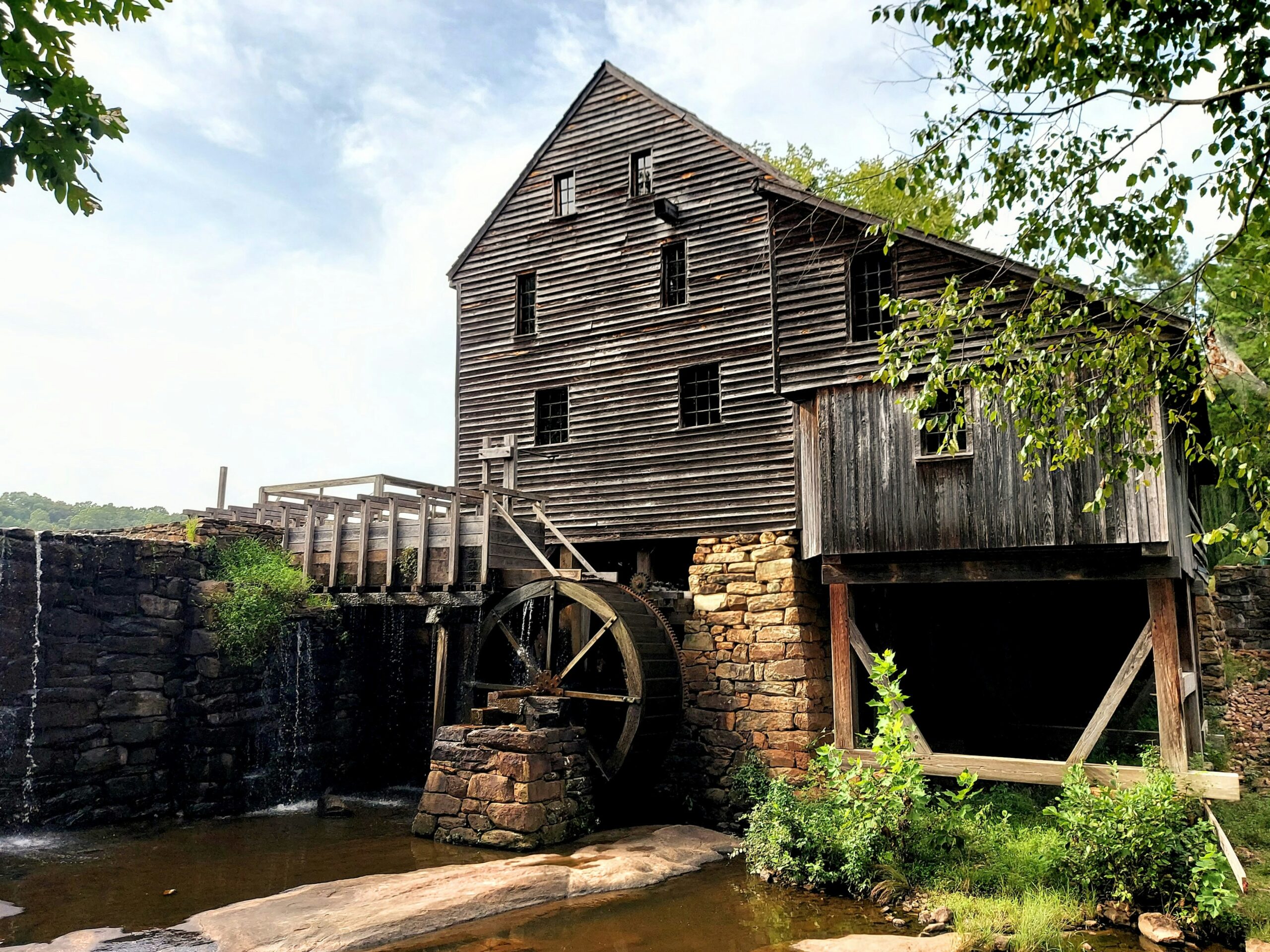
Nestled in the quiet countryside, the Sim Corder/Harrison Mill stands as a remarkable symbol of early American ingenuity. Though time has weathered its structure, the mill’s design and mechanics continue to spark fascination among engineers, historians, and preservationists alike. Built in an era when industry met nature with clever design rather than combustion engines, the mill exemplifies how innovation and sustainability once walked hand in hand. More than just a historical relic, it is a living classroom of mechanical brilliance that still has lessons to teach.
Mastering the Power of Water
One of the most compelling aspects of the Sim Corder/Harrison Mill is its water-powered operation. Long before electricity lit up factories and modern machines took over production, mills like this relied entirely on the natural force of flowing water. The mill was strategically located near a reliable stream, and from this simple yet powerful resource, it drew the energy needed to grind grain and power other machinery.
The mill’s water wheel, an engineering feat in its own right, converted kinetic energy from moving water into mechanical motion. Whether using an overshot, undershot, or breastshot wheel—depending on the specific design and topography—the mill captured the energy efficiently, with minimal waste. Gears and shafts transmitted motion from the wheel to various milling mechanisms within the building. This system not only made full use of renewable energy but did so with a grace and balance that modern systems often struggle to match.
The ability to harness nature without depleting it marks one of the greatest strengths of early engineering. Every board and beam of the mill worked in harmony with the environment, a lesson still relevant in today’s push for sustainable technology.
The Mechanical Heart of the Mill
Step inside the Sim Corder/Harrison Mill, and you’ll find a complex network of wooden gears, stone grinders, and pulley systems. Each component was carefully hand-crafted to fulfill a specific function, yet all worked together with precision. At the center of this system lies the millstone, the key tool used for grinding grain into flour or meal. These massive stones were not only perfectly balanced but also grooved in patterns that allowed them to shear kernels to a consistent fineness.
Above the grinding floor, a series of gears and shafts carried power upward and across the mill. Vertical and horizontal motion was seamlessly transferred through ingenious mechanisms, such as the lantern pinion gears and the great spur wheel. These parts, often made from hardwood like hickory or oak, were not only functional but also remarkably durable. Their construction required a deep understanding of force, friction, and momentum.
Equally impressive was the mill’s built-in automation capacity. Gravity-fed chutes and conveyor systems allowed materials to flow from one stage to another without requiring constant human intervention. Workers needed to monitor and guide the process, but the mill itself did most of the heavy lifting. This was not just a building—it was a machine, and every creak and clatter was part of its rhythmic, purposeful movement.
Design That Stands the Test of Time
The mill’s exterior and structural design reflect both utility and endurance. Heavy timber frames were assembled using traditional mortise-and-tenon joints, secured with wooden pegs rather than nails. This approach allowed for a certain degree of flexibility within the frame, making the structure more resilient to shifting ground or seasonal expansion and contraction. The result was a building that could literally move with the land—and survive for centuries.
The rooflines, window placements, and even ventilation were not arbitrary but carefully calculated to support the interior environment. Milling produces fine dust, which can be hazardous in confined spaces. The builders of the Sim Corder/Harrison Mill accounted for this with natural airflow systems that helped reduce the risk of fire and kept machinery cleaner for longer periods.
Even the mill’s footprint on the landscape was part of its sustainable design. Positioned to make full use of the natural slope and water flow, the mill required minimal environmental alterations. It is a prime example of how traditional engineering balanced human needs with environmental awareness.
An Educational Legacy
Today, the Sim Corder/Harrison Mill offers more than a window into the past—it provides a valuable educational resource for future generations. Its intricate systems are studied by engineers interested in mechanical transmission, energy efficiency, and sustainable building practices. Historians and conservationists analyze its construction methods to understand early American craftsmanship and community planning better.
Schools and universities have also begun incorporating the mill into curricula focused on environmental science, technology, and design. This living laboratory allows for real-time observation of gear dynamics, hydropower, and structural engineering in action. In this way, the Sim Corder/Harrison Mill continues to inspire new generations of problem solvers and innovators.
Preserving Genius for the Future
The ongoing conservation of the Sim Corder/Harrison Mill is not just about saving a building—it’s about preserving a way of thinking. The mill’s design demonstrates that with the right knowledge and creativity, it is possible to build systems that are both powerful and gentle on the earth. As modern society grapples with the challenges of sustainability, energy consumption, and resource management, the lessons found within the walls of this historic structure grow ever more relevant.
Thanks to the efforts of preservationists, engineers, and community volunteers, the mill remains a functional symbol of timeless innovation. Its wooden gears still turn, its water wheel still hums with life, and its legacy continues to turn minds toward the possibilities of thoughtful, sustainable engineering.